Safety
Every move matters.
Yard trucks, trailers, and people on foot share the same pavement. Our goal is zero harm, and our spotters follow these rules on every shift.
Our commitment
Your safety. Our priority.
That line opens our Spotter Orientation. The goal behind it is zero harm: everyone on the team goes home safe at the end of every shift.
Orientation covers yard rules, equipment inspections, coupling and uncoupling, backing, and defensive driving. It also covers the site itself: the buildings, the docks, the parking, and who to call on each shift.
The rules are enforced. Failing to report an accident, skipping a seat belt, and reckless driving are disciplinary offenses.
See our yard services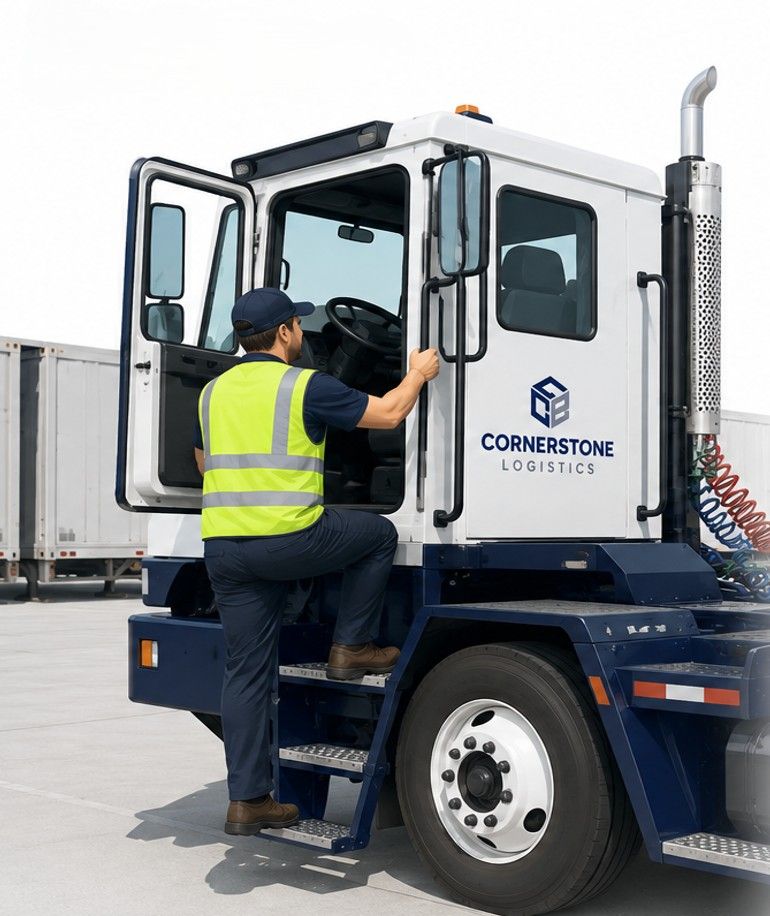
On every shift
Six rules our spotters follow.
-
Full pre-trip inspection
Before every shift, spotters check the truck’s tires, fluids, lights, mirrors, and seat belt and log it on a daily inspection form. Steer tires need at least 6/32 inch of tread, and drive tires 4/32.
-
Three points of contact
Spotters keep two hands and a foot, or one hand and two feet, on the truck every time they climb in or out. They face the truck, never jump down, and never get on or off while it’s moving.
-
Speed and people on foot
Yard trucks stay at 20 mph or less. If a spotter loses sight of a pedestrian or another vehicle, they stop and don’t move again until they’ve confirmed everyone is safe.
-
Get out and look
When a spotter isn’t sure the path is clear or the trailer will fit, they get out of the truck and check. They back at 1 mph or less.
-
Focus in the cab
Seat belts stay on whenever the truck moves, at any speed, and nobody rides outside the cab. Phones go through a headset with one ear uncovered, and spotters don’t text while operating.
-
Report it right away
Spotters report every collision, injury, spill, and hazard to their supervisor or central dispatch as soon as it happens, along with any unsafe work they see.
Coupling
Every hookup follows the same nine steps.
If a trailer isn’t locked on, it may slide off the fifth wheel. That’s why every hookup includes a tug test before the trailer is lifted.
-
Inspect the fifth wheel
Make sure it’s greased, working, and in the right position.
-
Plan the pull-out
Make sure you have room to pull the trailer away from the dock.
-
Line up the kingpin
Position the fifth wheel so it lines up with the trailer’s kingpin.
-
Back in slowly
Back to the trailer, shift into neutral, and set the fifth wheel flush with the bottom of the trailer.
-
Connect the air lines
Hook up the air lines and supply air to the trailer.
-
Lock on
Set the trailer brakes and back under until the fifth wheel locks onto the kingpin.
-
Tug test
Once you hear the lock, pull forward gently to confirm the trailer is securely connected.
-
Raise the trailer
Lift the trailer until the landing gear is off the ground.
-
Pull the chocks and go
Remove the wheel chocks if they’re in place, then move the trailer.
Put these rules to work in your yard.
Tell us about your site’s rules and traffic, and we’ll show you how we’d run your yard.